Hotel tech providers are patching poor design with cosmetic AI
Nearly every hotel system now claims to have AI. Look closely and most of it is doing a job the software should have done on its own. Here’s a test for telling the difference.
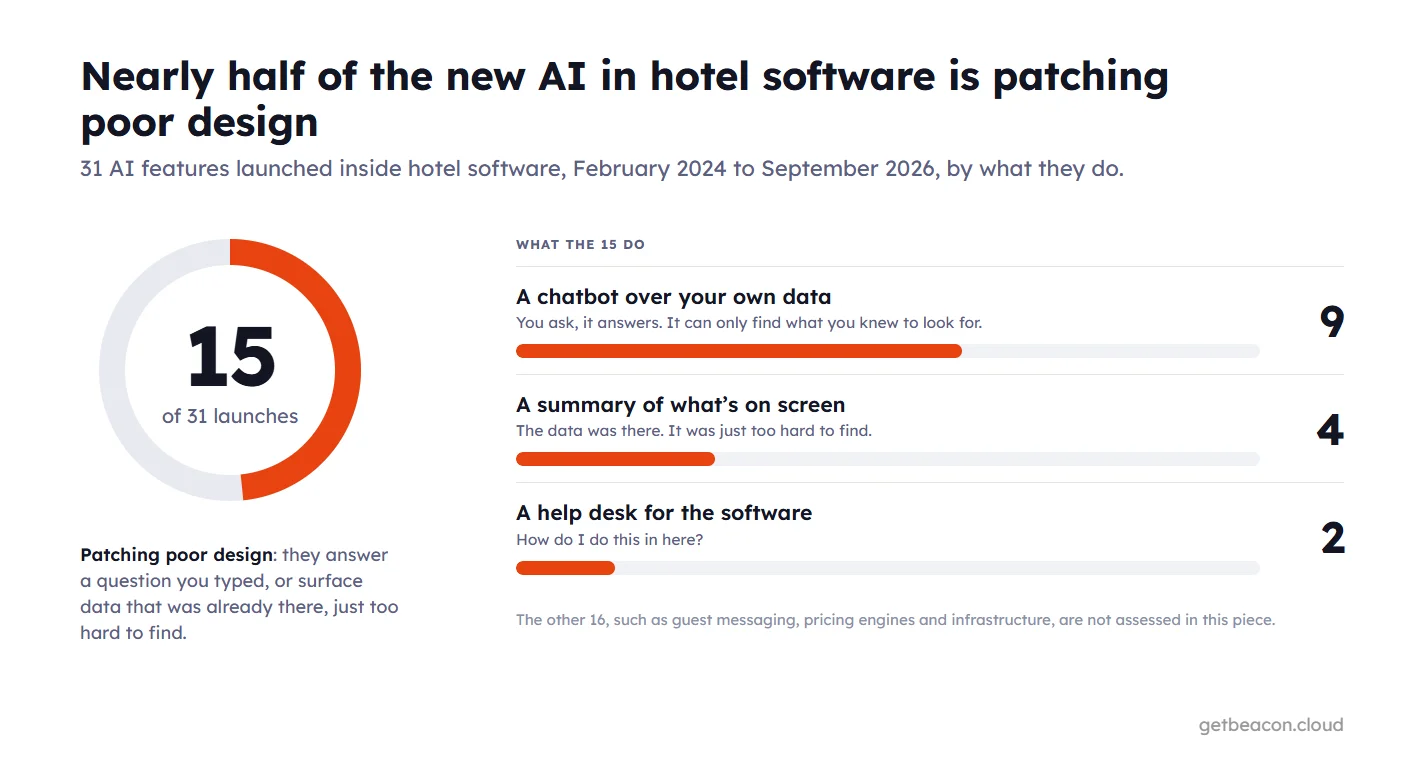
By my count, since the start of 2024 there have been 31 new AI features launched by existing hotel tech providers. Nine are, first and foremost, chatbots that allow you to ask questions about your own data. A few of those also promise alerts and actions, which is a claim the four questions further down can test. Four summarise what’s already on the screen. Two help answer questions from users about how best to use the software. The rest are mostly things like guest messaging and pricing engines.
Hotel Tech Report put it plainly in July: “The question is no longer whether hotel software has AI, because nearly all of it now claims to.”
But if you look more closely, you’ll quickly find that most of these “AI-first” solutions are cosmetic. They’re fixes for poor design.
That’s not to say they’re useless. On the rare occasion you have an odd question that needs answering, a chatbot that can quickly find the answer is handy. But if you need a chatbot to find last month’s ADR broken down by booking source, that’s a fix for a report that should have already existed.
They're taking a sledgehammer to a rusty old nail.
There are people in this industry with more standing than me who’d disagree. I’ll give them their say further down. First, here’s what to look for.
What does an AI patch look like?
Three patterns cover most of those launches, and once you’ve seen them you’ll spot them in every demo.
It answers questions the screen should already answer. One launch this summer showed a regional director asking which of their hotels were trending below budget on gross operating profit, and getting a sourced answer back in seconds. It’s a good demo. It’s also the first page any budget report should open on. If a question that simple needs a chat window, the report was never built to be read in the first place.
The industry knows this. In one 2025 distribution study of more than 700 hotel brands, 80% of hotels said they still spend up to two days a week on manual reporting. The fix being offered is a chatbot you can ask about it.
And the answer has to be right. Several of these tools carry the vendor’s own warning that the AI can make mistakes and that important answers should be checked, which puts you straight back into the report you were trying to avoid.
It summarises what’s already there. Several of these launches turn a page of numbers into a paragraph of text. That saves you a scroll, and not much else. When Australia’s securities regulator tested AI summaries against human-written ones in 2024, the humans scored 81% and the AI scored 47%. The assessors’ note says it all: “the original source material actually presented information better”.
That test used an early model with a week of tuning, so treat it as a warning rather than a verdict. But even when a summary is genuinely liked, it isn’t intelligence. The data was already there. It was just too hard to find, and that’s a product problem, not one that needs AI.
It only works if you already know the question. This is the one that really matters. A chatbot answers what you type into it. It can’t tell you about the Tuesday you didn’t ask about. It won’t notice that a segment grew midweek while it shrank at the weekend, or that the source at the top of your revenue table lost you money once the commission came out.
Those are the expensive problems, and they’re expensive precisely because nobody knew to look. MIT’s GenAI Divide report found the same thing outside hotels last year: chatbots “succeed because they’re easy to try and flexible, but fail in critical workflows”.
A chatbot answers the question you knew to ask. The expensive problems are the ones you didn’t.
Rule of thumb: if the software needs AI to answer a simple question, the software isn’t finished.
Why is everyone shipping it?
Because it’s visible, it’s quick to bolt on, and buyers have started to expect it. You can hardly blame the product teams. If a competitor announces an AI assistant on Monday, someone will be asking when yours is coming by Tuesday.
Gartner has a name for the wider version of this: “agent washing”, “the rebranding of existing products, such as AI assistants, robotic process automation and chatbots, without substantial agentic capabilities”. Its estimate is that only around 130 of the thousands of vendors claiming to offer agentic AI are the real thing, and that over 40% of these projects will be cancelled by the end of 2027.
Closer to home, Terence Ronson, who has advised hotels on technology for decades, gave the hotel version its own name in May. AI washing: “the practice of labeling standard rules-based software as ‘AI’ to justify a premium price”.
Hotels are adopting the shallow end first, too. In a study of 171 hotel chains published last October, 78% were already using AI. The most common use was a chatbot, at 42%, and most of those talk to guests rather than to the data. Only 6% had what the study called a comprehensive AI strategy. Another survey this May, of 500 properties, found that 98% of hoteliers had used AI in the previous six months, which tells you how low the bar for “using AI” has become.
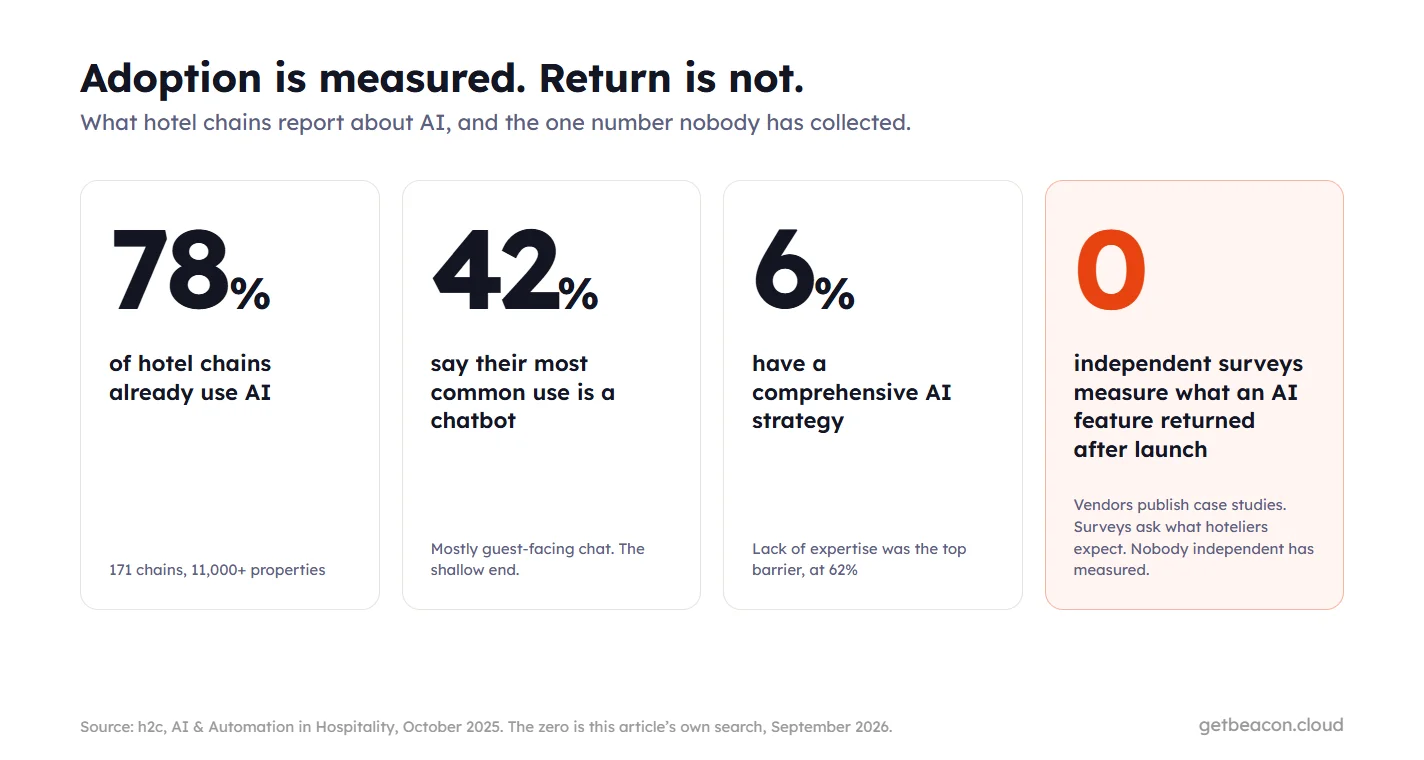
Here’s the part that stands out most. Plenty of surveys measure adoption. Vendors publish their own case studies. Surveys ask hoteliers what they expect AI to do for them. But nobody independent, as far as I can find, has gone back and measured what a feature actually returned after it launched. Nothing on usage three months on. Nothing on return. Nothing on whether anyone would miss it if it disappeared.
This is an industry that counts every room night. Yet the one question nobody has thought to ask is whether any of this has made a hotel more money. When nobody measures the return, the return isn’t the point. Being seen to have it is.
Rule of thumb: adoption is what vendors count. Return is what you count.
What should AI in hotel software actually do?
Show you something you’d never have gone looking for. That’s the whole test, and it’s the one that reliably separates a feature from a patch.
It isn’t about saving time, either. A chatbot saves time. So does a summary. The question is whether the AI finds revenue you didn’t know was there, a trend that was hiding in plain sight, or a risk that was building while everyone looked elsewhere. None of those turn up in answer to a question, because nobody knew there was a question to ask.
Take a segment that’s up 4% for the month. Nobody goes digging into a segment that’s up. But it’s up 4% only because it’s up 20% midweek and down a third at the weekend, and the discount that got signed off that month went to the nights that were already full. The report didn’t hide that. Nobody thought to look there. That’s the job for AI: reading every booking across every source, segment, room type and day of the week, and pointing at the thing you’d have walked straight past.
It isn’t a summary of a page, because no page holds it. It isn’t the answer to a question, because nobody asked one. It’s a finding, with the number behind it and what to do about it. The three mistakes revenue managers keep making covers exactly the kind of things that hide from a question and show up to a reader.
Now for the other side, because it deserves a fair hearing. Klaus Kohlmayr of IDeaS and Kelly McGuire of HSMAI have both argued that AI co-pilots free up revenue managers for the judgement that only a person can bring. And there’s the argument every chatbot demo makes: a general manager gets an answer at 9pm without waiting for the revenue manager to pull it in the morning.
They’re right, as far as it goes. AI does speed up the reporting, and a revenue manager who isn’t pulling data by hand has more of the day for decisions. The 9pm answer is a real convenience. It’s also exactly the report the general manager should have been able to open. But that’s the easy part, and it’s not where the value is. The value is in what the AI finds while it’s reading: the segment nobody was worried about, the source that only looks profitable, the shift that never crossed an alert threshold.
Speed gets you to the same answers sooner. AI should get you to answers you’d never have reached. Most of what’s being shipped does the first and is sold as the second.
Some vendors have clearly noticed. One launched its assistant in June with the line “not a bolt-on chatbot”. That tells you what the market has started to smell.
AI earns its place when it reveals what you never thought to look for. Everything else is a product gap with a chat window.
Four questions to ask any vendor
Ask these in the demo. They take five minutes and they work on every vendor, Beacon included.
- Show me something it found that I didn’t ask for. Not a question answered. A finding. If the demo can’t start without you typing, you’re looking at a search box.
- What would this answer look like without the AI? If the honest answer is “a report page”, ask why it isn’t one.
- What does it read, and how much of it? The page in front of you, or the whole dataset behind it. That’s the difference between a summary and an insight.
- What happened after launch? Ask for usage three months on, at a hotel like yours. Ask what it found that the hotel acted on. If nobody has measured it, you have your answer. And ask whether it’s on the invoice.
Where Beacon sits
Beacon sells an AI feature, so it has to take the test too.
AI Insights reads the booking data behind each Explorer page and comes back with what it found: positives, observations and concerns, each with the metric, the comparison and a recommendation. On question one, it starts without you typing anything, because surfacing things you didn’t ask about is its whole job. On question two, the page still answers the simple questions on its own, which is the point of building the page properly in the first place. On question three, it reads the bookings behind the page, not a sentence typed into a box. And it isn’t on the invoice: AI Insights is included with Explorer at no extra charge.
Question four is yours to ask, and you should. That’s the design. Whether it earns its place at your hotel is something to judge in a demo with your own data, not from an article. See how Explorer works.
Rule of thumb: judge the AI on what it found, not on how fast it answered.
Sources
- Hotel Tech Report, Hotel Tech Innovation Report: AI Trends & Tactics, Q2 2026, July 2026.
- The State of Distribution 2025, an industry study of 700+ hotel brands and 21,000+ properties.
- ASIC and AWS, Generative AI document summarisation proof of concept, tabled to the Australian Senate, May 2024. One model, one week of tuning, results the report itself says should not be extrapolated widely.
- MIT NANDA, The GenAI Divide: State of AI in Business 2025, July 2025. 300 public initiatives, 52 organisations interviewed, 153 senior leaders surveyed, across sectors, not hotels.
- Gartner, Over 40% of agentic AI projects will be cancelled by end of 2027, 25 June 2025.
- Terence Ronson, Eight questions every hotel leader should ask an AI vendor, Hospitality Net, 25 May 2026, and AI tools in revenue management are co-pilots, not autopilots, 15 May 2026.
- h2c, AI & Automation in Hospitality, October 2025. 189 responses and 26 interviews across 171 hotel chains, vendor-sponsored.
- Mews, Hotelier Survey 2026, May 2026. 500+ properties, vendor-run.
- Hospitality Net panel, The future of revenue managers in the age of AI co-pilots, May 2024.
- The count of 31 launches is from public press releases and vendor announcements, February 2024 to September 2026, classified by the author. Vendors are not named because the argument is about the pattern, not any one product.
Common questions
Labelling ordinary software as AI to make it look modern or justify a higher price. In hotel technology it usually shows up as a chatbot bolted onto a reporting tool, or a summary of data that was already there, just too hard to find. The test is whether the feature shows you something you would never have gone looking for, such as a trend hidden across thousands of bookings, rather than answering a question you already knew to ask.
They save time when the software underneath makes simple questions hard to answer. That is a fix for a product gap, not intelligence. A chatbot can only answer the question you knew to ask, so it will never find the segment slipping on Tuesdays or the source that looks profitable and is not. Judge it on what it finds unprompted, not on how quickly it answers.
Show you something you would never have gone looking for: the revenue opportunity, trend or risk hidden across hundreds or thousands of bookings, brought to you with the number and a recommendation. If the feature only answers questions the report should already show, or summarises what is already on screen, the product needed fixing first.